Showing posts with label notebook construction. Show all posts

9/8/14

No Boring Book of Centuries Allowed {Notebooking Construction}

The Book of Centuries has been a longtime resource for many home educators.  It is just not a new idea.  Classical and Charlotte Mason educators over the years have utilized this notebooking method to reap untold reward of learning and knowledge.  Okay, well, I don't have hard evidence or statistics to back that last statement up, but it is probably true. ;)

There are many resources across the internet to help you put together a Book of Centuries.  As a Charlotte Mason educator, this is a weekly work item for my children, and I have also incorporated it in my history classes at homeschool cooperative, as well.  The basic concept of a Book of Centuries is to learn, determine and record the important events of history, in chronological format.

The idea of a Book of Centuries page is to reflect, on one page, a set time period.  A good page entry should depict events sequentially, adding facts and pictures to make a beautiful snapshot of history on the page.  This enriching activity helps students to grasp the chronology of the time period in history they are studying.

Here are a few basic examples from our Book of Centuries:

We utilized Notebooking Pages' Book of Centuries pack for many of our entries.  It is  convenient and easy to print out the pages that my students need, and it gives a consistent uniform look to our Book of Centuries.  

Of course, we are homeschoolers, so we don't want EVERYTHING uniform.  Last year, we started adding some other creative and personal touches to our Book of Centuries that have made it an even more bright, vibrant and living collection of chronological history.  Here are some creative pages to add to your Book of Centuries:

  • Wanted Posters: The above photo are the Founding Father's Wanted Posters from our 1st Semester History Projects at co-op.
  • Biography Pages: Learning about the life of a man or woman that lived during the time period you are studying, is a profound and important tool in history.  When children connect with an individual, either by admiration or loathing, the door swings wide for true learning and loving that historical moment in time.


  • Political Cartoons: Studying political cartoons and devising your own humor of historical events or persons adds fun to any Book of Centuries.
  • Cover Page Contest:  We actually had a competition to see who could create the best Cover Page at homeschool cooperative and the teachers voted.  The picture above was our 2014 winner . . . never mind the winner just happened to be one of my kids. 
Here is a list of resources for building a Book of Centuries:

Have you tried using a Book of Centuries in your homeschool yet?

Joyfully Learning with You,
The Joyful Socks Mom 

Be sure to keep up with Joyful Socks on PinterestTwitterInstagram & Facebook

12/20/13

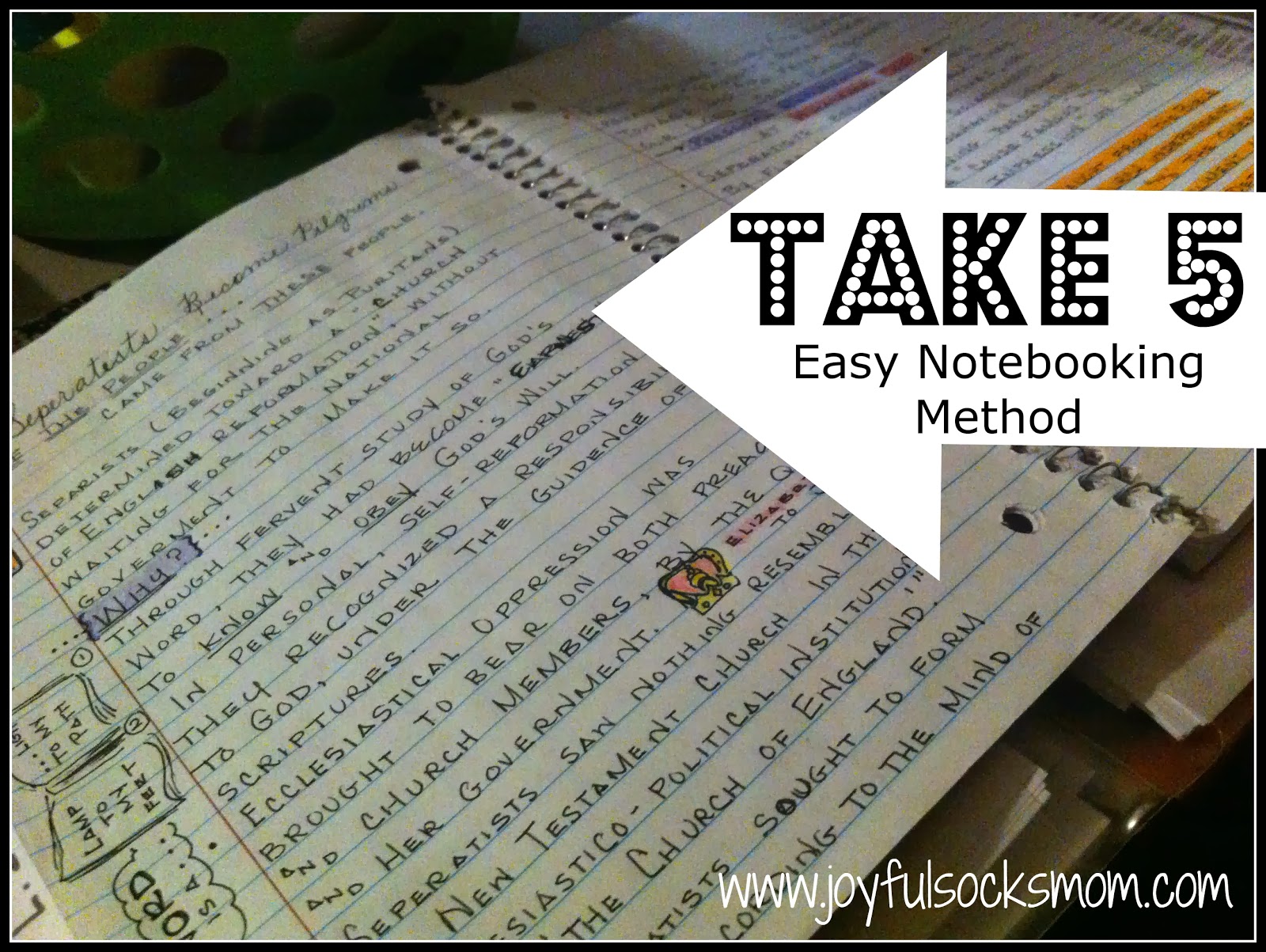
"Take 5" Easy Notebooking Method: Notebooking Construction


Notebooking is a useful tool in our daily home learning, one that take far less effort than most people realize.  Notebooking, in its simplest form, is one of the most effective means of encouraging a child's skills in observation, independent thought and learning, as well as artistic expression.  Unfortunately, many home educators do not utilize this tool due to being so often overwhelmed by the many resources available.  Sometimes, we make the process entirely too difficult, and just need to simplify.


When I began teaching history at the academy, I began re-evaluating the process that I used in Notebooking with my own children at home.  I needed to simplify the process in order to teach notebooking methods to my new students who had no previous notebooking knowledge (*gasp*), without taking up precious classroom hours.  

Notebooking is essential in our home education, and I wanted to give this gift of creative learning to my new students.  A student that is able to keep a notebook has excellent potential as a student and life-long learner.

In the process of my many hours of Pinterest gleaning research, I discovered a simple Notebooking assignment idea that paved the way for my creating the easiest method to teach notebooking skills, and helping my students produce excellent Notebooking pages on their own.  


I have lovingly dubbed this notebooking exercise "Take 5" Notebooking.  The students read or review their lesson, then they "Take 5" in their notebook.
  • Document 5 important or interesting facts from the lesson.
  • Create 5 illustrations to represent these facts.
  • Use 5 colors to complete the illustrations in the notebook.
This is a simple assignment with the potential for excellent outcomes for the student.  
  • The student gleans, continually, from the lesson or reading to find the information that they feel is important, or at least, interesting.  This promotes them thinking over the ideas in the living book or lesson the teacher has provided.
  • The student is building narration skills and note-taking skills that will continue to help them become excellent communicators.
  • The process of illustrating and coloring helps to ignite the creative spark in a child's imagination.  Picturing and envisioning the ideas from the reading or lesson is an essential element to help children retain what they have learned and make a permanent connection to the ideas they are learning.
  • The student utilizing this process has assimilated the information themselves, in reality teaching themselves, and providing themselves with a convenient way to review the ideas later . . . in their own notebook.
  • The process of this assignment helps a child to organize their own thoughts and begin expressing them effectively and ultimately more efficiently.
Here are a few examples of "Take 5" Notebooking assignments:


TAKE 5 on Luther & the 95 Theses
This "Take 5" did not have the 5 illustrations, but I love the creativity of using the Wittenburg church door as the center piece illustration.


TAKE 5: You can use printed clip art, magazine clippings, postcards and photos for your illustrations in notebooking.


I begin with the first "Take 5" Notebooking assignment on the first week of school.  My class is history, so we began with a History About Me: Take 5, but you can use this for any subject you are learning.  Example: Math About Me, Science About Me, Reading About Me, Writing About Me, etc.  Rather than creating a Take 5 on a lesson, they are using themselves as the "idea" to communicate.  It is an easy way to begin teaching the notebooking method, set expectations for excellent work and learn a bit more about my students.


Remember, the key to successful notebooking is you being a guide to your child.  Allow them a chance to meditate and communicate the ideas that they believe are important.  Give them the tools and allow them to use the tools in their learning.

Here are some more posts on notebooking that you may find useful:

This post is a part of the Notebook Construction series
 

Joyfully Learning with You,
The Joyful Socks Mom 

Be sure to keep up with Joyful Socks on PinterestTwitterInstagram & Facebook

Here are some more homeschool resources we recommend: 

11/18/13

10 Reasons Notebooking Helps Home Educated Students: Notebooking Construction

* This post may contain affiliate links.  Please see our full statement of disclosure here.  Thank you for your support.*

Notebooking is an essential element that I added to my teaching style years ago, both at home and at the academy where I instruct.  I have found that through the years it is a method that is consistent in its ability to promote a love of learning in my students.  

You can utilize the notebooking method in any and every subject that you teach, making it a versatile tool for any educator.  It is a method of teaching that in my experience, has gradually promoted self-education and excellence in all of my different students throughout the years.
As a life-long learner myself, I have enjoyed using this method to broaden my own horizons in the subject that I most enjoy.


Can you tell how enthused I am about notebooking?  Well, don't just bask in my enthusiasm, here are some more reasons to explore the world of notebooking in your own home education environment:

1.  Washington was an excellent notebooking student.  Leonardo Di Vinci's notebooking efforts are world renown.  If it worked for them, it might as well work for you.

2.  Students will tend to take more time, effort and pride in producing something that innately belongs to them.  When students create, they own.  When they own, they learn.


3.  The daily use of notebooks helps make grading a smoother, stream-lined and user-friendly process for the home educator.  Whew!  Can I get an, "Amen" on that one ladies?  All of the student's work is at your fingertips, ready to go.

4.  Students who learn the importance of good note taking skills, have a more convenient and easy-to-understand method of reviewing or studying at a later time.


5.  Notebooking is an excellent means for students to learn and develop good organizational skills.

6.  When a student uses their notebooking skills, they are exercising their ability to express their own thoughts and opinions about the subjects they are learning, promoting self-government and independent thought.


7.  As a student is able to express better what they believe, they can better develop a biblical worldview that allows them to defend their faith, with confidence.

8.  Notebooking can be an wonderful creative-based method, essential for a student's need for an artistic outlet.


9.  Keeping a notebook is a great way to keep record of what your student has learned and accomplished throughout the year.

10.  Note taking skills are of high value to any student that is college bound.

I hope that you will see the amazing benefits of learning, along with your children  and begin to utilize notebooking in your home educating.  You can find lots of notebooking inspiration on my Pinterest Board.

Check-out some joyfully recommended NOTEBOOKING products:

Joyfully Learning with You,
The Joyful Socks Mom 

Be sure to keep up with Joyful Socks on PinterestTwitterInstagram & Facebook

Read more joyful posting here:
This post is part of my Notebooking Construction monthly highlighted series:

9/6/12

Notebooking Construction: Off the Map Geography for Your Notebook

NOTEBOOKING SUBJECT BY SUBJECT: Geography

Geography is the next stop on our subject by subject tour of notebooking.  The key to success is to keep the geography, itself, exciting and engaging.  The process of notebooking can always follow when the fun is complete, not that notebooking isn't fun all by itself, because it is.  Geography just does not excite, unless your nerdy like me.  Here is a look at Geography notebooking without boredom. 
1.  Passports & Postcards - Create Passports to begin any journey in geography, then you'll be a globetrotter without having to dribble a basketball.  State Notebooking is also a great way to teach US geography and history together.  We enjoyed exchanging Postcards with other home educating families last year.  We made use of these and decorated our notebooking pages with them.
Simple Schooling 50 Days of 50 States

2.  FOOD!  Studying the various countries and cultures during geography can be made even more interesting with the culinary creations from around the globe.  We have eaten Ratatouille from France, Thai Spring Rolls & Lettuce Wraps, Sausages and Mash from England . . . get creative and get the kids involved.  
     

3.  Make Mapping Multi-sensory - Maps can be boring, especially if you have a hands-on learner.  Here are some excellent mapping and other hands-on geography ideas to keep them engaged: 

4.  Surveys & Scavenger Hunts - These are great ways to get your kids engaged in geography outside!  This is survey which could be used to survey family and friends.  Then you map and find all the places around the country and globe where your family and friends have been.  Here is a Scavenger Hunt for US geography.

5.  Create Models That Teach!  Here our the best geography teaching models: 
Remember to take pictures of your child studying or making these models.  This will help them to create a notebooking page about what they learned later.

Earth Eyes
PHOTO CREDIT
Notebooking Printables for Geography:
Hope that you all have fun notebooking and "globetrotting" at the same time!


This post is a part of the Notebook Construction series


Happy Notebooking!

 
The Joyful Socks Mom 

Be sure to follow all of the HISTORY LIVE! fun on my Pin Board!

WHERE WE ARE AT?  Homeschooling On The Cheap

Here are some more homeschool resources we recommend: 
  • Take a journey through Notebooking Success! Best notebooking resource for home educators. . .and beyond.
  • Wonder Maps is the homeschool geography that moms and kids can both give an A+

Photo Credits for Geography Button: Lego Map guy by ntr23, Clay Earth by Derringdos, Globe by Balaji Bharadwaj, Statue of Liberty by Puzzler4879, Old Geography Book by sassyarts, Geography Girls by brentdanley


8/29/12

Notebooking, Subject By Subject: Math


We have used notebooking for a couple of years now and I have had a ton of questions from homeschoolers, family, and friends alike, about the process of notebooking we use.  I had a recent request from a special reader friend that set me to thinking, then inspired me, and then I began constructing!  

I wanted to spend some time sharing the process, construction and practical methods that we using in notebooking and will spend the next month reviewing each notebook we use in our homeschool, subject by subject.  Today we will be begin with Math, because it is my favorite a hugely important building block in academics.  (P.S.  There are some FREE math printables at the end of this post, so hang on!)

Notebooking in Math - this actually seems to be the subject that most people assume is the most difficult to notebook.  I would have to submit that it is, in fact, the easiest!  Here are a few ideas to use in Math Notebooking that may help to decode the process:

1.  Let your child copy the problems & DON'T buy the worksheets!  No matter what math curriculum you are using, notebooking will work for them all.  

Example:  We use a combination of "living math", Saxon Math, Life of Fred, Ray's Arithmetic  and Teaching Textbooks.  With ALL of these curriculums we employ the use of notebooking.  My children simply take notes during their lesson, copy the problems by hand and then complete practice problems in their notebook.  This process keeps them sharp and continuing to mentally process during each math lesson, and additionally (ha ha), it keeps us good stewards and NOT consumers.  (The less worksheets the better!)

2.  Use illustrations when completing math computations.  The example shown above is showing how we use multiplication in the Bug's notebook.
She has used communative properties, addition properties, illustrations and arrays to complete her multiplication.  IT'S NOT JUST DRILL AND KILL!

3.  Have your child create a Math Office or Math Resource section in their Math Notebook.  This helps them to govern themselves during the learning process and to go find the resources that they need in order to complete a math problem.  Here are some great resources we have used in our notebooks:
4.  Use notebooking to document and discuss great mathematicians and their contributions.  Here is a great post on using the book Mathematicians Are People, Too by Jimmie discuss and discover more about the great mathematicians from history.
eratosthenes1
Photo Credit:  jimmiehomeschoolmom via Flickr
5.  Create a Family Math Night scrapbook.  This is a great way to show enthusiasm during the learning process.  Take pictures during your Family Math Night and let your student notebook with scrap-booking and writing.  They can do example problems showing what they learned during Family Math Night.  They can also give written narratives explaining what they learned and what they enjoyed the most about the evening.


And here you go as promised.  My friend needed help with her kiddo notebooking skip counting.  Here are Skip Counting notebooking pages I made for her and am sharing with you.  Enjoy!
My Skip Counting Graph NB Pages FINAL


Happy Notebooking!
 
The Joyful Socks Mom 

Where we are at? 
Homeschooling on the Cheap!

Here are some more homeschool resources we recommend: 
Statement of Disclosure: This post contains affiliate links. The blog owner receives a smallportion of sales generated from these links, which helps to support this blog. The blog writer does not receive compensation for thoughts or opinions expressed on this blog. Thank you for your kind consideration.