Showing posts with label notebooking. Show all posts

9/8/14

No Boring Book of Centuries Allowed {Notebooking Construction}

The Book of Centuries has been a longtime resource for many home educators.  It is just not a new idea.  Classical and Charlotte Mason educators over the years have utilized this notebooking method to reap untold reward of learning and knowledge.  Okay, well, I don't have hard evidence or statistics to back that last statement up, but it is probably true. ;)

There are many resources across the internet to help you put together a Book of Centuries.  As a Charlotte Mason educator, this is a weekly work item for my children, and I have also incorporated it in my history classes at homeschool cooperative, as well.  The basic concept of a Book of Centuries is to learn, determine and record the important events of history, in chronological format.

The idea of a Book of Centuries page is to reflect, on one page, a set time period.  A good page entry should depict events sequentially, adding facts and pictures to make a beautiful snapshot of history on the page.  This enriching activity helps students to grasp the chronology of the time period in history they are studying.

Here are a few basic examples from our Book of Centuries:

We utilized Notebooking Pages' Book of Centuries pack for many of our entries.  It is  convenient and easy to print out the pages that my students need, and it gives a consistent uniform look to our Book of Centuries.  

Of course, we are homeschoolers, so we don't want EVERYTHING uniform.  Last year, we started adding some other creative and personal touches to our Book of Centuries that have made it an even more bright, vibrant and living collection of chronological history.  Here are some creative pages to add to your Book of Centuries:

  • Wanted Posters: The above photo are the Founding Father's Wanted Posters from our 1st Semester History Projects at co-op.
  • Biography Pages: Learning about the life of a man or woman that lived during the time period you are studying, is a profound and important tool in history.  When children connect with an individual, either by admiration or loathing, the door swings wide for true learning and loving that historical moment in time.


  • Political Cartoons: Studying political cartoons and devising your own humor of historical events or persons adds fun to any Book of Centuries.
  • Cover Page Contest:  We actually had a competition to see who could create the best Cover Page at homeschool cooperative and the teachers voted.  The picture above was our 2014 winner . . . never mind the winner just happened to be one of my kids. 
Here is a list of resources for building a Book of Centuries:

Have you tried using a Book of Centuries in your homeschool yet?

Joyfully Learning with You,

The Joyful Socks Mom 

Be sure to keep up with Joyful Socks on PinterestTwitterInstagram & Facebook

12/20/13

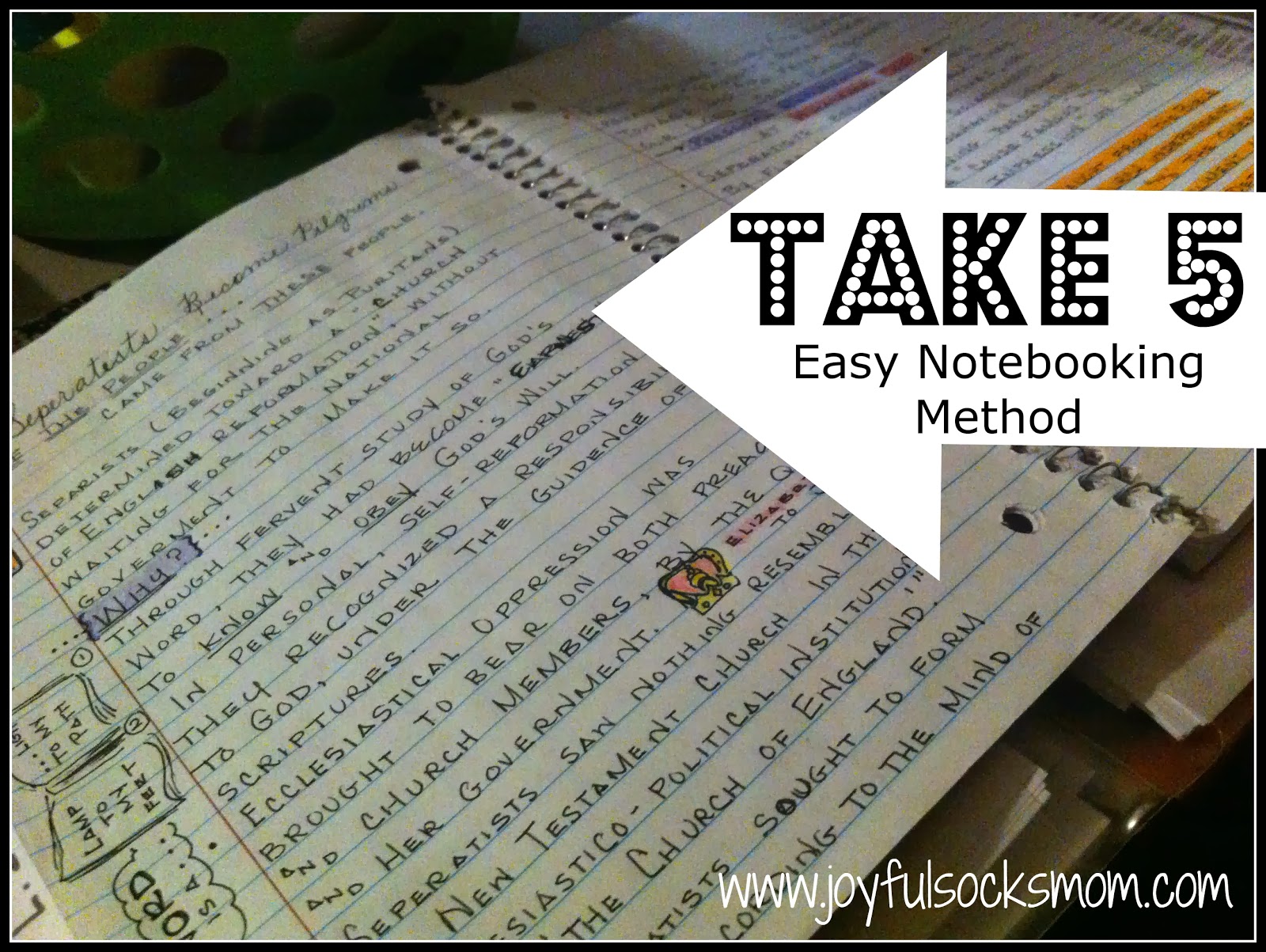
"Take 5" Easy Notebooking Method: Notebooking Construction


Notebooking is a useful tool in our daily home learning, one that take far less effort than most people realize.  Notebooking, in its simplest form, is one of the most effective means of encouraging a child's skills in observation, independent thought and learning, as well as artistic expression.  Unfortunately, many home educators do not utilize this tool due to being so often overwhelmed by the many resources available.  Sometimes, we make the process entirely too difficult, and just need to simplify.


When I began teaching history at the academy, I began re-evaluating the process that I used in Notebooking with my own children at home.  I needed to simplify the process in order to teach notebooking methods to my new students who had no previous notebooking knowledge (*gasp*), without taking up precious classroom hours.  

Notebooking is essential in our home education, and I wanted to give this gift of creative learning to my new students.  A student that is able to keep a notebook has excellent potential as a student and life-long learner.

In the process of my many hours of Pinterest gleaning research, I discovered a simple Notebooking assignment idea that paved the way for my creating the easiest method to teach notebooking skills, and helping my students produce excellent Notebooking pages on their own.  


I have lovingly dubbed this notebooking exercise "Take 5" Notebooking.  The students read or review their lesson, then they "Take 5" in their notebook.
  • Document 5 important or interesting facts from the lesson.
  • Create 5 illustrations to represent these facts.
  • Use 5 colors to complete the illustrations in the notebook.
This is a simple assignment with the potential for excellent outcomes for the student.  
  • The student gleans, continually, from the lesson or reading to find the information that they feel is important, or at least, interesting.  This promotes them thinking over the ideas in the living book or lesson the teacher has provided.
  • The student is building narration skills and note-taking skills that will continue to help them become excellent communicators.
  • The process of illustrating and coloring helps to ignite the creative spark in a child's imagination.  Picturing and envisioning the ideas from the reading or lesson is an essential element to help children retain what they have learned and make a permanent connection to the ideas they are learning.
  • The student utilizing this process has assimilated the information themselves, in reality teaching themselves, and providing themselves with a convenient way to review the ideas later . . . in their own notebook.
  • The process of this assignment helps a child to organize their own thoughts and begin expressing them effectively and ultimately more efficiently.
Here are a few examples of "Take 5" Notebooking assignments:


TAKE 5 on Luther & the 95 Theses
This "Take 5" did not have the 5 illustrations, but I love the creativity of using the Wittenburg church door as the center piece illustration.


TAKE 5: You can use printed clip art, magazine clippings, postcards and photos for your illustrations in notebooking.


I begin with the first "Take 5" Notebooking assignment on the first week of school.  My class is history, so we began with a History About Me: Take 5, but you can use this for any subject you are learning.  Example: Math About Me, Science About Me, Reading About Me, Writing About Me, etc.  Rather than creating a Take 5 on a lesson, they are using themselves as the "idea" to communicate.  It is an easy way to begin teaching the notebooking method, set expectations for excellent work and learn a bit more about my students.


Remember, the key to successful notebooking is you being a guide to your child.  Allow them a chance to meditate and communicate the ideas that they believe are important.  Give them the tools and allow them to use the tools in their learning.

Here are some more posts on notebooking that you may find useful:

This post is a part of the Notebook Construction series
 

Joyfully Learning with You,
The Joyful Socks Mom 

Be sure to keep up with Joyful Socks on PinterestTwitterInstagram & Facebook

Here are some more homeschool resources we recommend: 

11/22/13

True Heroes: The Pilgrims and Trusting Providence Mini-Unit

* This post may contain affiliate links.  Please see our full statement of disclosure here.  Thank you for your support.

During this time of year, it is all too easy to rush past the giving of thanks and run straight into the holly-dazed hysterics that some would like to call Christmas.  Don't tune out yet, I'm not going on one of my rants . . . well, not today, at least.  What I would love to share with my friends is an opportunity to pause and truly give thanks to God for our heritage.  There is no better way to begin, than by giving consideration and reverence to the plight of the people we know as, the Pilgrims.
ORIGINAL PHOTO CREDIT via Compfight.com cc
*Editor's note: I found this "True Heroes" post especially challenging, considering all of the "anti-Puritan" views that pollute the main stream media culture.  I want to reassure my readers that I scoured and searched to eliminate any historical malpractice that I could detect in the resources that I researched, in order to bring you historical sound history, with a biblical worldview, personal opinions omitted.  I happen to believe that you, and your children, are intelligent enough to form your own opinion.

Pilgrims & Trusting Providence Mini-Unit:
  • READ-A-LOUD About the Pilgrims:
---> The Pilgrim Story - I enjoyed reading the history myself from this classic work.  It is an excellent resource and helps build a better understanding of the outstanding trials and circumstances that God brought the Pilgrims through.  
--->Stories of the Pilgrims by: Margaret B. Pumphrey, is an excellent read-a-loud for the entire family.  The image below will take you to an online reader at Heritage History.
[Frontispiece] from Stories of the Pilgrims by M. B. Pumphrey
  • STUDY THE PILGRIM LEADERS ---> William Bradford: The best resource for learning about the Pilgrims comes directly from the hand of William Bradford, long-standing leader and governor of Plymouth.  His work Of Plymouth Plantation is detailed, accurate and clearly gives way for other generations to observe and rejoice in the Providence of God over our lives.  Of Plymouth PlantationPublic Domain Copy, or Buy it Here. ---> John Robinson: Bradford described Robinson as one of those "godly and zealous preachers" in his writings.  Robinson did not make the journey with the Pilgrims to the New World, but was a great leader of the Pilgrims and deserves a pause to look at.  ---> William Brewster: Brewster was an early member of what became the Pilgrim church in Scrooby, England.  The church originally met in the home he was renting from a high-ranking official in King James' court.  He had much to risk and much to loose, as one of the more wealthy members of the church.  Brewster was the elder that traveled to Plymouth with the Pilgrims. Begin reading At Scrooby Inn from Stories of the Pilgrims to learn more about these Pilgrim leaders.  ---> Miles Standish: Miles Standish was not a Pilgrim, but the captain of the small band of soldiers that traveled to the New World with the Pilgrims. Here is an excellent resource The Adventures of Miles Standish from America First by: Lawton B. Evans, here is a chapter called The Story of the Pilgrim Fathers, from This Country of Ours by: H.E. Marshall that mentions Standish.  You may also enjoy studying this classic from Longfellow, The Courtship of Miles Standish, and here is the LibriVox FREE Audio.
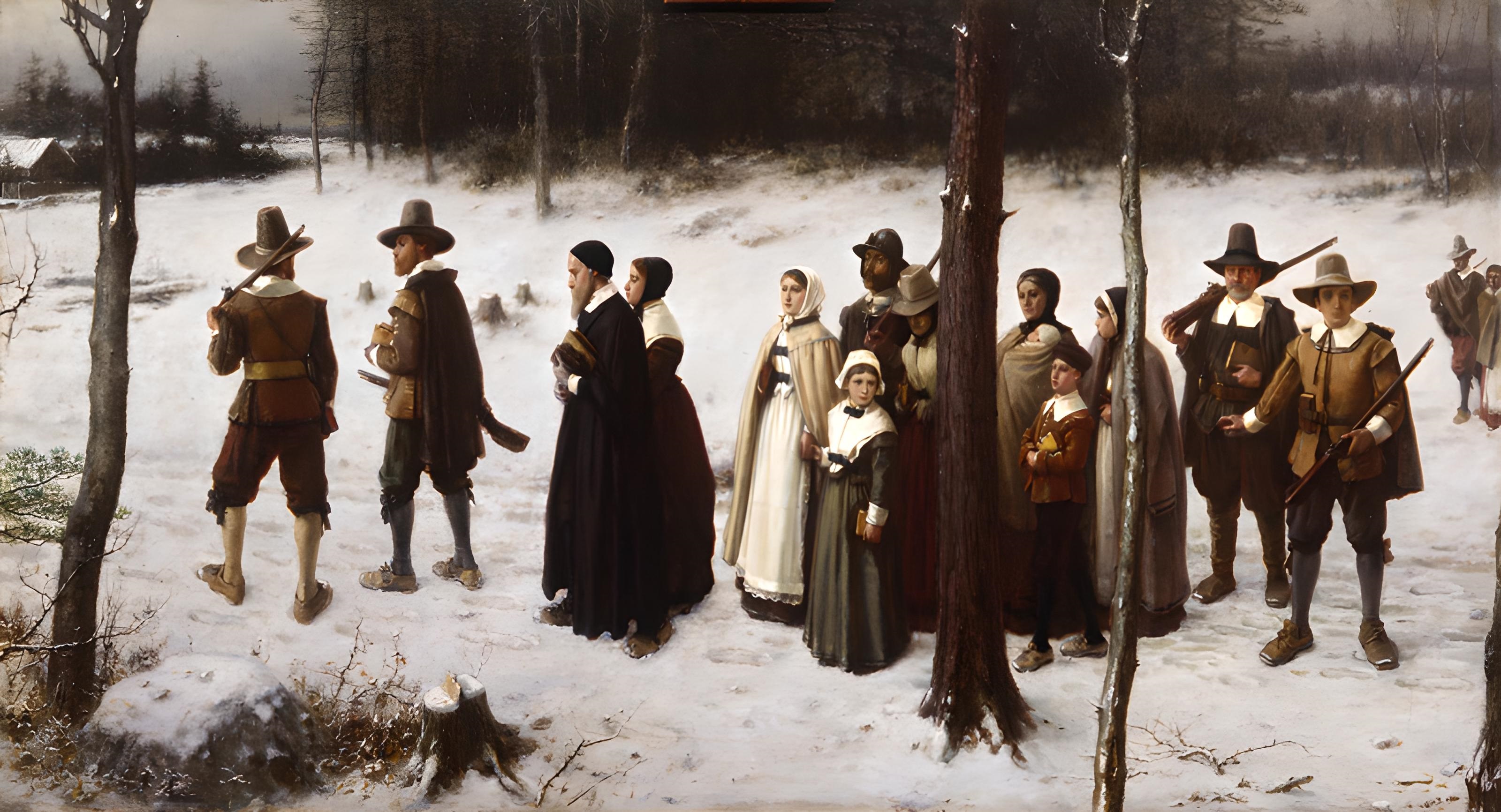
File:George-Henry-Boughton-Pilgrims-Going-To-Church.jpg
  • Notebooking Ideas for Thanksgiving: 
*Postcards from Plymouth: Pretend you are a child on the Mayflower, create a postcard & paste it in your Notebook.  Now write a letter to a friend back in Holland or Scrooby, England in your Notebook*

*Write a historical fiction short story from the first-person view of a Native American living near the Pilgrims.*

*Create a Thanksgiving Menu, like a restaurant menu and place in your notebook.  Go shopping and price all of your items.*

*Find your favorite Thanksgiving recipes and document the recipes in your Notebook.*


File:Embarkation of the Pilgrims.jpg
thanks giving the first Thanksgiving

thanks giving First Thanksgiving in America
thanks giving landing of the pilgrims
  • THE PATH OF PRAISE: Wonderful resource from Homeschool Freebie - The Path of Praise RADIO SHOW is a radio drama special beginning with William Bradford and the Pilgrims, and follows the heritage and history behind the holiday.
thanks giving The First Thanksgiving Gerome

  • More Thanksgiving Fun: 
Free Thanksgiving Lacing Cards, Free Printable Gratitude Journal, Thanksgiving Skip Counting Mazes, Road Trip Activity Book for the Thanksgiving trip, Thanksgiving Scavenger Hunt

I hope you will find the time to remember the contributions of the Pilgrims to our country's proud and most humble heritage.  Many prayers for blessings and giving thanks for all of you, my friends, this Thanksgiving.

Joyfully Learning Alongside You,
The Joyful Socks Mom 

This post is part of our monthly historical mini-unit educational series:
ORIGINAL PHOTO CREDIT via Compfight.com cc
Do you have an idea for the True Heroes series? True Heroes features a person, or persons, that meet specific criteria:
  • Historically significant individuals
  • Held openly Christian values & actions that matched those values (does this mean there were perfect, no, of course not)
  • Humbly served to better their society and world
Send you suggestions by commenting below!

Be sure to keep up with Joyful Socks on PinterestTwitter & Facebook!


11/18/13

10 Reasons Notebooking Helps Home Educated Students: Notebooking Construction

* This post may contain affiliate links.  Please see our full statement of disclosure here.  Thank you for your support.*

Notebooking is an essential element that I added to my teaching style years ago, both at home and at the academy where I instruct.  I have found that through the years it is a method that is consistent in its ability to promote a love of learning in my students.  

You can utilize the notebooking method in any and every subject that you teach, making it a versatile tool for any educator.  It is a method of teaching that in my experience, has gradually promoted self-education and excellence in all of my different students throughout the years.
As a life-long learner myself, I have enjoyed using this method to broaden my own horizons in the subject that I most enjoy.


Can you tell how enthused I am about notebooking?  Well, don't just bask in my enthusiasm, here are some more reasons to explore the world of notebooking in your own home education environment:

1.  Washington was an excellent notebooking student.  Leonardo Di Vinci's notebooking efforts are world renown.  If it worked for them, it might as well work for you.

2.  Students will tend to take more time, effort and pride in producing something that innately belongs to them.  When students create, they own.  When they own, they learn.


3.  The daily use of notebooks helps make grading a smoother, stream-lined and user-friendly process for the home educator.  Whew!  Can I get an, "Amen" on that one ladies?  All of the student's work is at your fingertips, ready to go.

4.  Students who learn the importance of good note taking skills, have a more convenient and easy-to-understand method of reviewing or studying at a later time.


5.  Notebooking is an excellent means for students to learn and develop good organizational skills.

6.  When a student uses their notebooking skills, they are exercising their ability to express their own thoughts and opinions about the subjects they are learning, promoting self-government and independent thought.


7.  As a student is able to express better what they believe, they can better develop a biblical worldview that allows them to defend their faith, with confidence.

8.  Notebooking can be an wonderful creative-based method, essential for a student's need for an artistic outlet.


9.  Keeping a notebook is a great way to keep record of what your student has learned and accomplished throughout the year.

10.  Note taking skills are of high value to any student that is college bound.

I hope that you will see the amazing benefits of learning, along with your children  and begin to utilize notebooking in your home educating.  You can find lots of notebooking inspiration on my Pinterest Board.

Check-out some joyfully recommended NOTEBOOKING products:

Joyfully Learning with You,
The Joyful Socks Mom 

Be sure to keep up with Joyful Socks on PinterestTwitterInstagram & Facebook

Read more joyful posting here:
This post is part of my Notebooking Construction monthly highlighted series:

10/31/13

Martin the Reformer {Reformation Day}: True Heroes

* This post may contain affiliate links.  Please see our full statement of disclosure here.  Thank you for your support.
Martin Luther

A lone monk with 95 real issues for the church of his day, nailed his complaints to his "community board", or the church door at Wittenburg, Germany, October 31st, 1517.  The challenge?  To get other church leaders and theologians to pay attention and come closer in faith toward God . . . he did just that, and he changed the world in the process!

Romans 1:17 NKJV
For in it the righteousness of God is revealed from faith to faith; as it is written, “The just shall live by faith.” 

The celebration of Reformation Day, to our family, is a practice in giving thanks to God for His amazing Providential hand in history.  We choose to give honor to God and recognize His uncanny ability to use whomever He chooses to shape and form the times.

We are focusing specifically on the life of Martin Luther, the reformer, as we prepare to celebrate a day of thanksgiving this Reformation Day.  Here are some resources and activities we will be using:

Our main reading source will be Mystery of History, Volume III
Heritage History's Christian Europe e-books on CD - I cannot tell you how much I have enjoyed having these e-books!  We come back to them over and over again.
HERE IS A GOOD LINK TO BASIC REFORMATION READING

Selected Works of Martin Luther HERE

Nice selection of information regarding the actual celebration of Reformation Day.

Notebooking: Reformation Notebooking Page & The Five Solas Copywork from the Notebooking Fairy.

Notebooking: UNIT STUDY & PRINTABLES for the Reformation from Homeschool Share.

Lapbooking: UNIT STUDY & LAPBOOK for Martin Luther and the Reformation from I Choose Joy.

Listen to the "Battle Hymn of the Reformation".

Coloring Page the YOUNG MARTIN LUTHER.

This post is a part of our True Heroes series for October.  We are giving thanks for those who would stand, at the peril of loosing this life, to share what God has, in His infinite wisdom, revealed to them.  Not that they were perfect, for Martin the reformer was not, nor are any of us, he was just courageous and with zeal for the Lord.
ORIGINAL PHOTO CREDIT via Compfight.com cc

Joyfully Learning with You,
The Joyful Socks Mom 

Be sure to keep up with Joyful Socks on PinterestTwitterInstagram & Facebook

1/29/13

Art Education: Dad Does It Different, Not Wrong!

Being away for the weekend at the Homeschool Winter Summit meant a little planning needed to be done.  Dinners.  Laundry.  Housework.  The basics, plus I didn't want to leave Dad hanging on Friday with kids that were out of their homeschool swing.  

After some discussion we both decided that a trip to a local art museum would be a great homeschool field trip.  The Scout needed to visit an art museum for a Boy Scout Merit Badge and I needed the kids to review some European Art for enrichment to our Harmony Fine Arts curriculum.  Win, win!

Well . . .

Mommy's way of doing the museum:
Weeping Willow by: Claude Monet
Sounds simple enough.  Right?

Wrong!

Daddy's way of doing the museum:

  • The Modern Art Museum
  • Lots of engaged discussion
  • Tons of interacting with the art
  • Documenting their journey on camera


So, was dad's way wrong?  Nope!  Not a bit.  As a matter of fact, the kids have been chatting my ear off about their trip & I bet you a million they learned much more doing it dad's way.

Am I so blessed to have such an amazingly engaged, extra handsome home educating father for my children, or what!?!

P.S.  They went to the Kimbell Art Museum and completed mommy's assignments first . . . then they went and did art dad's way.

My vote?  Dad should now be in charge of field trips!  Anyone second that motion?

Home Educating with Joy!
The Joyful Socks Mom 

Big props for the photos goes to my 13 year old son, The Scout.  Good job!